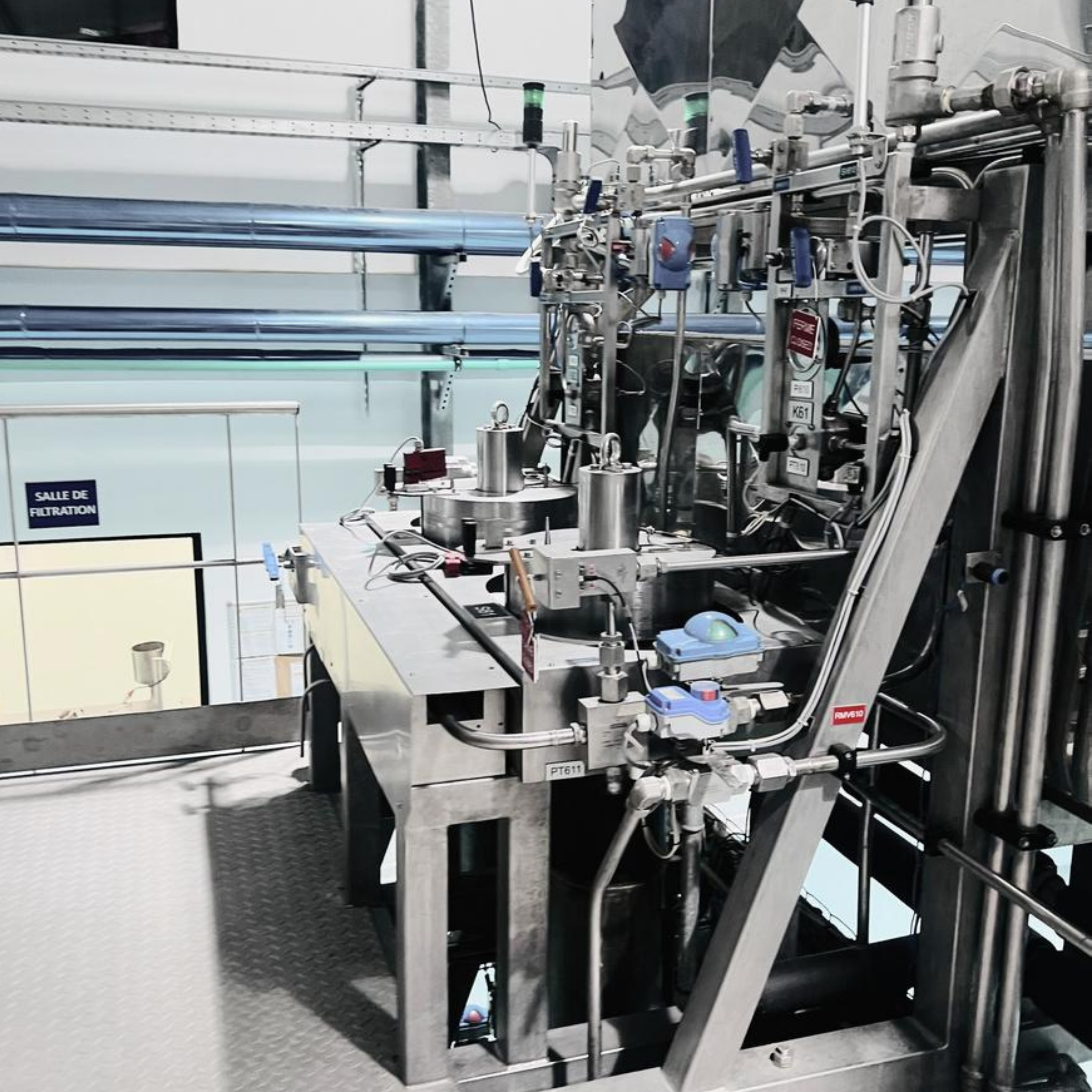
Supercritical CO₂: extraction and botanical extracts
May 2026Updated
Supercritical CO₂ extraction uses pressurised carbon dioxide to separate compounds from plants. Understand the process, the extracts it produces and the criteria that matter for formulation.
What is supercritical CO₂?
Above its critical point, approximately 31.1 °C and 73.8 bar, carbon dioxide becomes a supercritical fluid. Its density and solvent power vary with pressure and temperature. Operating conditions are selected for the plant and target composition, rather than simply set at the critical point.
How does supercritical CO₂ extraction work?
- Select and prepare the botanical material, including drying and particle size.
- Pressurise and heat CO₂ to the chosen conditions so it flows through the plant and dissolves target compounds.
- Reduce pressure progressively in the separators to recover several extraction cuts.
- Recover and reuse the CO₂, then analyse the composition of the cuts.
At Actifs Précieux, extraction uses no added water as its extraction medium and no petrochemical solvent such as hexane. CO₂ itself is the solvent. This does not mean that the entire industrial site uses no water or energy.
What is a supercritical CO₂ extract?
Depending on the plant and operating conditions, a CO₂ extract may contain aromatic compounds, oils, waxes or other lipophilic molecules. A seed extract, an aromatic resin fraction and a floral extract differ in composition and solubility. The process name alone does not establish their performance.
Extraction versus fractionation
Extraction already recovers several cuts during separation. Fractionation further refines a selected stream to concentrate specific molecular families for aromatic, sensory or functional objectives. The distinction is recovery versus finer separation, not a single extract versus many fractions.
CO₂ extracts or essential oils?
Steam-distilled essential oils mainly contain volatile compounds carried by the steam. CO₂ extraction can also capture less volatile and lipid compounds, depending on its conditions. The resulting profiles can therefore differ for the same plant. Neither method is universally superior: the choice depends on aroma, composition, solubility and the intended application.
Applications in perfumery, cosmetics and nutrition
Perfumery development focuses on aromatic profile and formulation compatibility. Cosmetic applications require attention to lipid fractions, stability and sensory properties. Nutrition requires ingredient-specific quality and regulatory assessment. An extraction method is not in itself evidence of efficacy or authorisation for use.
Benefits and limitations
CO₂ offers adjustable selectivity and can reduce heat exposure compared with some processes. Depressurisation separates it from the extract. High-pressure equipment, compression energy, preparation and yield still need evaluation. Pure CO₂ is less effective for some highly polar compounds; published methods sometimes use co-solvents. Final quality and environmental impact must be measured case by case, not inferred from the word supercritical.
How should you select an extract?
- Identify the botanical species, plant part and origin.
- Compare analytical profile, markers, solubility and storage requirements.
- Review batch analysis and the technical and regulatory documents required for your intended use.
- Test a sample in your formulation before agreeing specifications and production scale.
APEX combines pilot trials, analytical monitoring and industrial equipment to support development. Through TheoCapt™, we are also developing cocoa-shell valorisation into aromatic, lipid and bioactive fractions. This research explores coproduct potential without assuming the performance of future applications.
Scientific references
These publications document the technology, its parameters and its limitations. They do not constitute validation of our specific ingredients.
Actifs Précieux